 MALLORCA – The secret garden
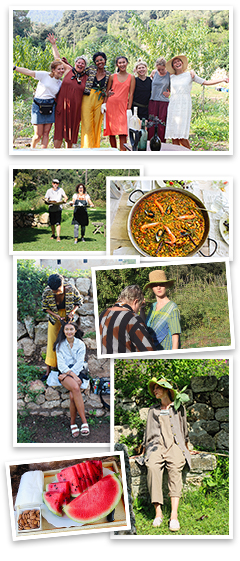
Green olive groves and vineyards flash past as our van takes us deeper into the mountains. The sun has just started to kiss the mountain peaks, and the sky is already beaming milky white from the sun’s first rays. Inside the van, the entire team of seven women is assembled: a photographer and her assistant, a hair and makeup artist, a stylist, a copywriter and two models. All still slightly sleepy from our departure at the crack of dawn.
As soon as we turn onto the road to Valldemossa, to stop outside Son Viscos, we sense that this is going to be extraordinary. A building in golden brown stone stands at the foot of the mountain. Beyond it, a large green garden extends along the stone walls. We catch a waft of thyme, rosemary and mint in the air. Metre-high palm tree kale and curly kale plants are swaying in the gentle breeze, and giant tomatoes are turning dark red under the sun. This is the location where we’ll be shooting our new summer designs. What a sensational setting!
Son Viscos is one of the many agritourism farm-style places to stay in Spain. This rustic-chic B&B offers meals composed of locally-sourced organic produce growing just outside the window. Brit Michael Roberts bought the house twenty years ago, when it was in ruins. The green stone paths in the garden had been completely swamped by the vegetation.
“Nobody even knew there was this huge garden hidden away beyond the house. The stone walls and farmhouse may actually date back to the 15th century, but had grown over and been forgotten,” he recounts.
But as soon as they started clearing the rampant vegetation, they discovered stone paths, fine walls and the remains of centuries-old millwheels. An ancient garden, which is now lush with new food crops, cacti, wild herbs and stunning botanical specimens.
“We want people to immerse themselves in this rural experience of flavour and ambience. And to sample all that the garden has to offer”.
Woolly sheep gaze at us as we get ready for the photoshoot. We hang the new summer collection pieces in the magnificent trees, and wander by the jasmine and peppermint. The camera is hard at work all day. When our bellies rumble, we’re served quiche made with the produce growing all around us, followed by ensaimada, Mallorca’s traditional spiral pastries. The forces of nature are all around. In this setting, Gudrun’s green summer styles really come into their own.
Learn more, and book your own stay at Son Viscos here: http://sonviscosvalldemossa.com
MIRÓ’S MALLORCA
While holidaying with her sister in Mallorca, Gudrun paid her first visit to the Joan Miró Foundation and museum, where she was captivated by the colourful setting. Here, among the cacti, creative architecture and history, was a world of inspiration. After her visit, Gudrun painted cactus watercolours, and sketched ideas for the summer collection. Now, that same collection was to be shot against the backdrop of her original inspiration. Full-circle amazing, right?
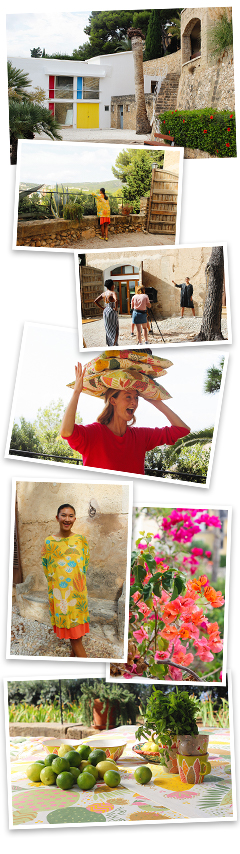
To reach this beauty spot, we negotiate the winding streets in our large van. No easy passage through these small spaces. On arrival, we’re instantly immersed in Miró’s world. The surrealist artist Joan Miró spent some 30 years of his life living and working in this amazing place. There are three different unique buildings, all of which tell part of the story of his life. His own studio, Sert Studio, designed by his friend the architect Josep Lluís Sert, is striking for its colourful doors. His other magical studio, the 18th-century Finca Son Boter, was where he created his sculptures and other artworks. Finally, the large Moneo Building is a gallery showing some of his principal works.
The architecture is magical, with dramatic lines offset by the blue sky. At Son Boter, the 18th century stone finca, we photograph our new homeware. Here in the garden, we have a stunning view of the mountains. And inside the studio, there’s the sense that Miró has only just left for a brief siesta. His brushes and tools are still there, as if awaiting his return. Miró reportedly said:
“I want everything that I leave behind to stay just as it is when I am gone.”
Today, Joan Miró’s grandson Joan Punyet Miró is on location to appear in a documentary about his grandfather. We’re in the garden, shooting a selection of our summer-season home accessories, which had been inspired by Miró’s cactus garden. There’s all kinds going on, and curious tourists gather around us to stare.
The bright colour pops of Gudrun’s designs and Miró’s fascinating world are a perfect combination. We even found some outsize brushes, easels and sheets of paper to use doing the photoshoot to create that artistic ambience. And didn’t it just turn out beautifully?
Learn more about Joan Miró Foundation here: https://miromallorca.com/en/
COLOURFUL BERLIN
Berlin is one of the most creative cities in the world. With its cultural and historical legacy, Berlin – which became Germany’s capital once more after the country’s reunification in 1990 – has evolved into one of Europe’s most visited metropolises.
Berlin is an utterly effervescent city – there is so much to see and do here! Magnificent buildings, modern residential areas, art exhibitions, awesome graffiti and 200 museums. But Berlin is also a city of war history, trendy shopping districts, classic cafés, wiener schnitzel, currywurst, canals and loads of parks. A visit to Berlin always leaves you with a taste for more… On this spread, join us behind the scenes during our photo shoots in chilly Berlin.

MITTE was a district in East Berlin before the fall of the Berlin Wall. Today it is an important financial, entertainment and shopping area. The incredible Chinese artist Ai Weiwei, among others, makes art here in an old brewery.
THE BRANDENBURG GATE
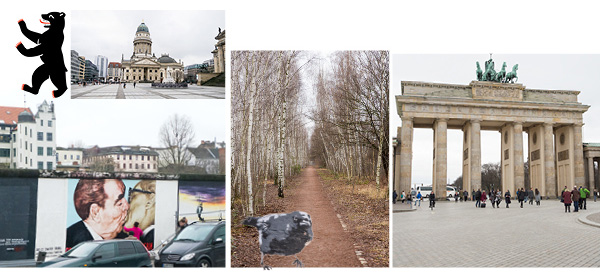
The gateway to Berlin from 1788. Today, it symbolises peace and the unification of the city. We came here for a photo shoot early one cold morning. It was incredible to be in such a historic place – almost completely alone. But it wasn’t long before the area was crawling with students and tourists.

THE TV TOWER in Mitte is Germany’s tallest building and a landmark that can be seen throughout Berlin. Designed by an architecture collective in 1960, it has 368-meter-high views and a rotating café.

THE TEAM IN BERLIN
The crew takes a break to warm up with coffee. Photographer Mats Widén; photo assistant Joakim; models Stina, Lina and Annelise. Hair/makeup artist Tuija, and Monica, Ida, Claes and Elias from Gudrun Sjödén.
THANK YOU JENS! During the week in Berlin, we had excellent assistance from our Swedish guide, Jens, who has lived in Berlin for 30 years. He’s incredibly knowledgeable and has a wonderful energy. Hurray!

COLOURFUL AND URBAN LOCATIONS
Street art can be found everywhere in Mitte: sometimes murals cover entire facades, while other places have just a small detail. Plenty of surprises await those of us who love colour, form and creativity.
Graffiti and a Swedish snowscape
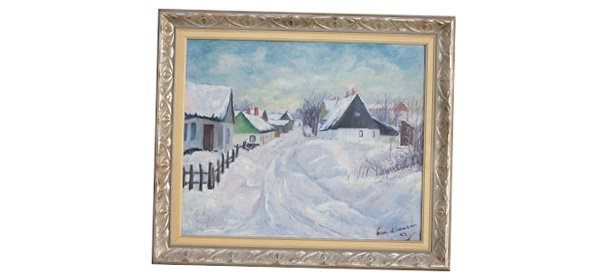
Look at what we found in an antiques shop by the wall of graffiti – a lovely winter landscape painted by a Swedish artist – different forms of art.
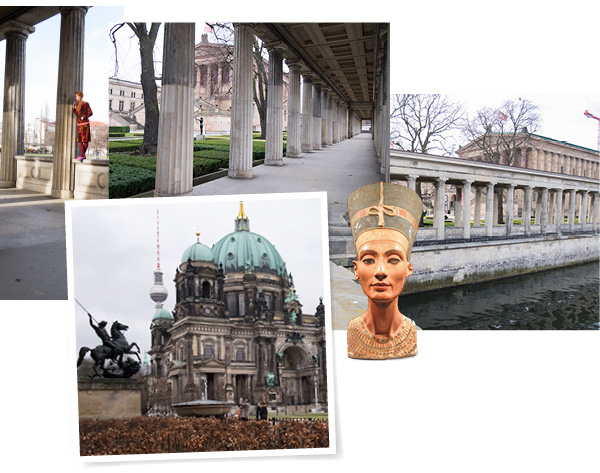
Berlin has over 200 museums. A little island in the Spree river is home to Berlin’s classic museums. We found classical columns here – a striking contrast against the rough and urban…

GUDRUN & HERBERT in Berlin’s most beautiful square: Gendarmenmarkt. Internationally renowned conductor Herbert von Karajan led the Berlin Philharmonic in many phenomenal musical performances here. Gudrun’s huge store is located to the side of the square at Markgrafenstrasse 32.
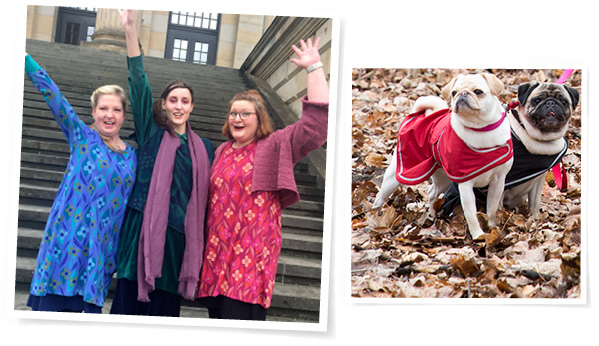
The staff from the Gudrun store around the corner came by and shared their fabulous energy with us.
Vesterålen, Northern Norway
Vesterålen is an archipelago in Northern Norway, on the same latitude as Greenland and Russian Murmansk.
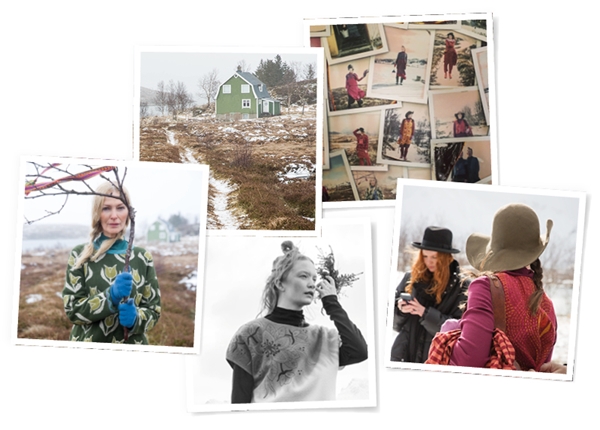
For our Christmas photoshoot, we wanted to combine spicy inspiration from India with pristine Arctic wilderness.
We envisaged snow-clad plains
and breath-taking natural panoramas. After some googling and inputs from our photographer Mats Widén, we homed in on Vesterålen, near the Lofoten Islands of Northern Norway.
Here, husband and wife team Unni and Asle Sordahl run a guesthouse in a converted school building from 1864.
After two flights on small planes from Oslo, we ended up on a huge inflatable boat! Let the adventures commence...!
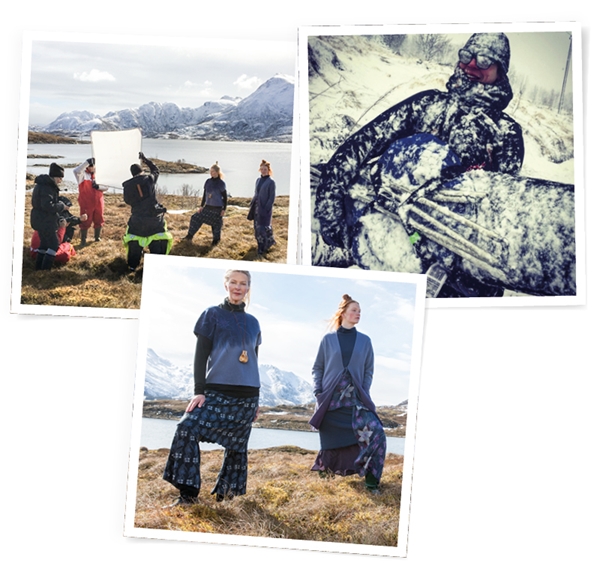
Changeable weather
Wonderful wilderness. The Arctic backdrop is magnificent with its deep fjords, high snow-capped mountains, straits, rivers and wetlands.
In the morning, the sun shines bright, but by afternoon, we’re in a snow blizzard...
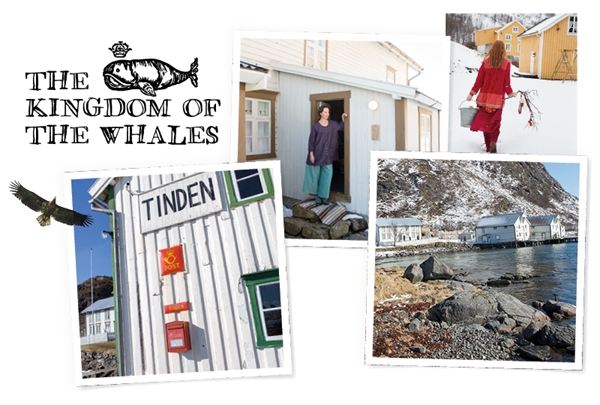
The water here abounds with whales. In fact, this is the only place in the world where whale sightings are 95% guaranteed! That said, we didn’t actually spot a single whale – but we did see some amazing white-tailed eagles… which was quite a sight!
Tinden, a fishing hamlet since the 16th century
On Tinden island, the fishermen were out at sea for months at a time. We can only begin to imagine the harshness of life for fishing communities back then. Today, the buildings have been restored by a foundation to convey a sense of life as it was lived here.

Unni & Asle
What a couple! Their hospitality towards us was just the best. Every dining experience opened with a presentation by Asle of the ingredients and the local area. We were then served a meal of local fish, meat, vegetables and berries. All grown locally and prepared to perfection.

RIB rocket!
To reach Vesterålen, we flew from Oslo, taking two flights on small planes. Then onwards by coach to the coast, where a large open RIB (rigid inflatable boat) and Asle were waiting to take us to Finvåg. This was certainly an experience!
Fine fisheries
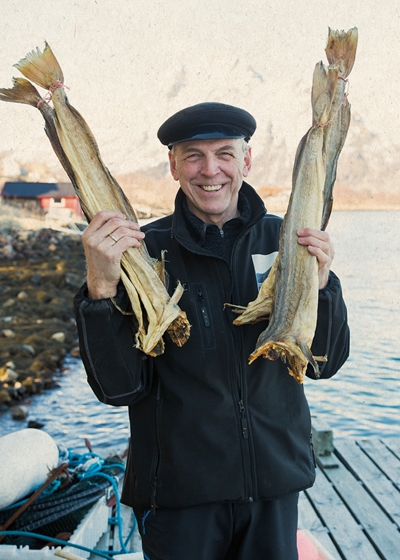
The fisheries are still Norway’s biggest industry.
Norway lands huge volumes of saithe, plaice, mackerel, ling, herring, trout, salmon, haddock, cod, flounder, Atlantic wolffish, turbot and heaps of crabs and mussels – all turned into culinary delights.
Our trip to Peru and Bolivia 2016
From an autumn inspired by North America, for winter 2016 we took off to South America. Our winter collection spans the green theme of the Amazon Rainforest to alpaca knits for cool heights. We consider the plains of Patagonia in Chile and the Amazon jungle of Brazil, but later land in Peru. So much to see, so little time! We add two stops in Bolivia because Diana who worked on the collection and has joined us on our trip actually comes from Bolivia.
We are away for eleven days and visit eight places. We travel by plane, minibus, train, boat and bike and stay at many different hotels. This is a breath-taking trip with many astonishing sights to take in: traces of the fascinating ancient culture of the Incas, the tropical heat of the Amazon Rainforest, the misty heights of the Andes and La Paz, the islets of Lake Titicaca and the salt flat of Bolivia. Not to mention all the adorable alpacas we got to pet and all the wonderful people we met! We returned with so many experiences, sights, shots and stories.
 Lotta Nilsson’s Venice
Our very own Venice city guide, Lotta Nilsson, has lived in Italy for 25 years and is an expert on the culture and lifestyle of “Bella Italia”. She is also a delight for her bubbly wit and is very likely to break out into song! Read on here as she shares her top Venice tips:
Benvenuti a Venezia! If you’ve never visited Venice, then it’s a must, and those of you who’ve been before are no doubt keen to return! What do visitors do in Venice? They walk! This famed city is built on islands in a lagoon, surrounded by canals.
The name Venice probably conjures up visions of the gondolas; the amazing 11 metre boats built specially for this floating city. In the 16th century, there were more than 10,000 gondolas, which the wealthiest families competed to decorate in splendour. Take a trip along one of the narrow canals in one of the some 400 gondolas that exist today, and you get a sense of just how breath-taking this city was in its grand past; the palace painted and ornamented in yellow, green, red and blue by one of the many artists and architects such as Titian, Tintoretto, Veronese, Sansovino and Palladio.
As your gondola plies the water, Venetian music streams out of one of the many churches that now serve as concert halls. Antonio Vivaldi, one of the many sons of Venice, served as a priest in “La Pietà” church, where he also taught the girls’ choir that captivated visitors in the 18th century. Today, you can hear Vivaldi’s “The Four Seasons”.
Marco Polo – who discovered an unknown world, was another famous Venetian. "Il Milione” is the Italian name for Marco Polo’s travelogue, and the district that was his birthplace.
The Carnival of Venice is a special time for the city and its inhabitants. Back in the 1700s, this was an event open to everyone in society, and was celebrated in spectacular costumes and distinctive masks. To this day, carnival-goers still sport the “bauta”, a distinctive black veil concealing the hair, eyes and neck, typically made from Burano lace. This is topped by a tricorne hat and the full-face mask, and then a dashing black “tabano” cape. Men, women, rich and poor alike all attended. At times, the carnival lasted all year! When Napoleon conquered Venice in the late 1700s he banned the carnival – for there was no knowing the man or woman behind the mask!
But Napoleon held that the only square in Venice, Piazza San Marco, was a ‘drawing room fit only to be canopied by the sky’. This main location also has superb cafés such as Caffè Quadri, Caffè Lavena and Caffè Florian, patronised over the centuries by luminaries the likes of Dickens, Goethe, Wagner and Proust. To this day, these are great places to enjoy a cup of coffee – or, in the case of Caffè Florian, hot chocolate made to a secret recipe – accompanied by orchestral music in the café-chantant style.
The Piazzetta, the little square, is dominated by the Doge's Palace, from where “La Serenissima” was governed. The palace once contained countless prison cells, including the feared lead-roofed gaol, from which Casanova made his famed escape. Ponte dei Sospiri, “The Bridge of Sighs”, leads to one such prison cell. The palace recounts the history of Venice over the 1100-year reign of the Doges.
Unmissable attractions include the city’s many bars, or “Bacari”, where you simply have to sample a “Spritz” (Prosecco and mineral water with a dash of bitter liqueur such as Aperol or Campari). Another famous spot is “Harry’s bar” (behind St. Mark’s Square), where you can sample Hemingway’s favourite tipple, a “Bellini” – Prosecco and freshly-puréed peaches. In the evenings, the local restaurants, “osterie”, are filled with hungry people keen to enjoy Venetian cuisine. Do try the traditional delicacies of “Fegato alla Veneziana” (calf’s liver and onions) or “Cicchetti” (a platter of mixed snacks) at Squero. Alternatively, Osteria Trefanti offers excellent fresh fish and other seafood dishes.
Benvenuti a Venezia!
 Wiveka Wachmeister’s Paris
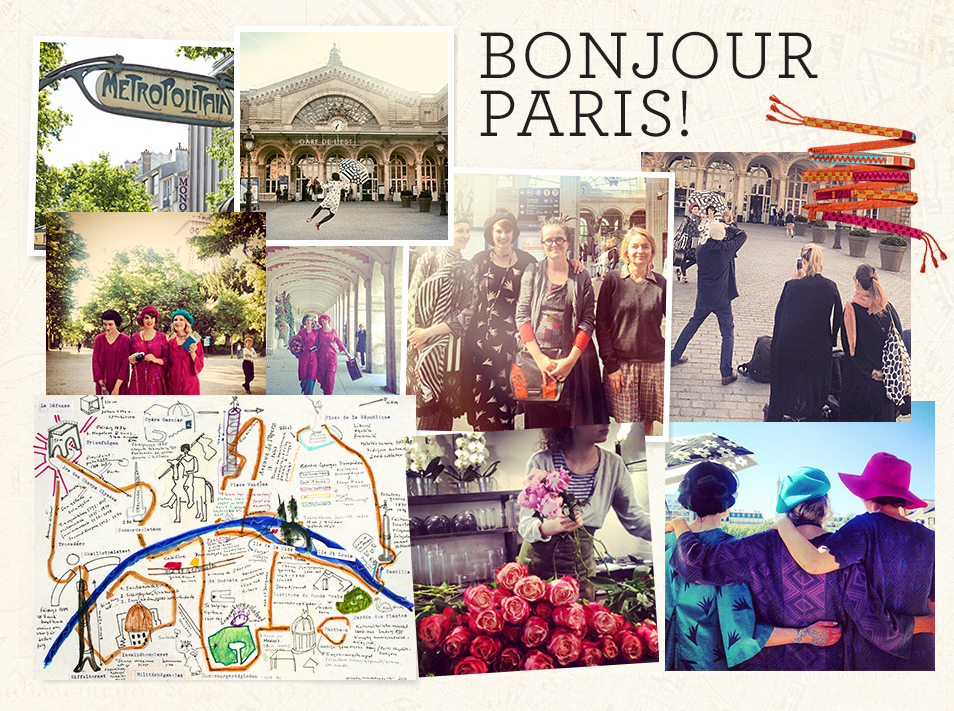
Swedish Wiveka is a long-standing resident of Paris, and is both an artist and city guide. She knows the “City of Light” like the back of her hand, and as you can see here, is also an ace at drawing beautiful maps!
Following stints as a seamstress, costume and set design assistant and puppeteer and more besides, I’ve worked for many years as an artist and guide. Paris is the ultimate city to be a guide in, and in which to take guided tours for any culture vulture. Montmartre is one of my favourite Paris hangouts, especially the district behind the hill itself where Sacré Coeur is located. This part is like a little self-contained town in the city, with strips of cosy cafés, restaurants and bars away from the more touristy precincts.
Saint-Germain-des-Près with all its boutiques and possibly the city’s cheapest pharmacy is also a top destination. I also like spending time in the Luxembourg Garden people-watching, reading and drawing. This is a tranquil greenspace, except at weekends when the park fills with people and takes on a whole new atmosphere. One of my latest discoveries and regular haunts just nearby is La Cuisine de Philippe, a bistro famed for its souffles. I also enjoy wandering along the Canal Saint-Martin, taking a rest by the quay or visiting the little arts & crafts boutiques such as the one owned by Swedish jewellery designer Viveka Bergström.
A few favourite addresses:
Il Brigante, 14 rue du Ruisseau, Paris 18e.
Italian restaurant serving the best thin-base pizzas.
Bar aux Rèves 89 rue Caulaincourt, Paris 18e.
A cool hole-in-the-wall bar, patronised by locals enjoying a drink or dinner at one of the few tables.
Hôtel l'Ermitage, 34 rue Lamarck, Paris 18e.
www.ermitagesacrecoeur.fr
A little hotel near Sacré Coeur. Nice patio with a view.
Marché de l'Olive, 10 rue l'Olive, Paris 18e.
Food market in fab, late-19th century premises and recently renovated. One of the few covered markets in Paris.
Martin Luther King park, 147-151 rue Cardinet, Paris 17e.
A relatively recently established modern park; perfect for jogging, strolling or relaxing on a sun lounger.
Le Bon Marché, 24 rue de Sèvres, Paris 7e.
The oldest department store in Paris. Has all the big labels and a wonderful lingerie department. And above all, don’t miss the food department. A paradise for gift-shopping or for foodies stocking up on French delicacies. Fine herbs and spices, teas and preserves.
Isabel Marant, 1 rue Jacob, Paris 6e.
My most favourite of all the French designers and available at several locations, including the department stores. Fairly pricey, but with bargains to be had in the sales. Hippy chic floaty cotton styles.
La Cuisine de Philippe, 25 rue Servandoni, Paris 6e.
French cuisine with great-value menus. Specialises in sensational sweet or savoury souffles, plus other great dishes too.
Citypharma, 26 rue du Four, Paris 6e.
Pharmacy with great deals on leading brands. Beware: things are cramped and chaotic!
Viveka Bergström, Rue de la Grange aux Belles, Paris 10e.
Fine jewellery designed by one of Sweden’s best design exporters.
Palais de Tokyo, 13 avenue du Président Wilson, Paris 16e.
Gallery that often shows contemporary art. Open late and also contains a restaurant and bar.
Marché aux puces Porte de Vanves.
This flea market is a bit more manageable than the sprawling one at Porte Clignancourt. Mainly has antiques, but bargains are still to be had.
Lisboa - ELÉM, BAIXA, BAIRRO ALTO, ESTRELA & ALFAMA
Inner-city Lisbon is divided up into many different quarters, each of them very distinctive; dive in and go see it all…
History is ever-present in Lisbon. The city evokes the rule of the Islamic Moors, its Christian recapture and Portugal’s voyages of discovery, starting in 1415. The traces of this diverse heritage are all in evidence in this capital, where the grand buildings of the past are mixed with new, futuristic architecture.
Lisbon enchants, not only with its historical highlights, but also its dynamic cultural life spanning from traditional fado to modern art. This is also a place to enjoy traditional Portuguese fare and innovative cuisine based on local produce.
During our week in this metropolis with its 550,000 inhabitants (2 million with its outlying districts) we pack in all kinds of experiences. We visited Sintra in the shady forests west of Lisbon, the westernmost extent of continental Europe, Cabo da Roca, many cathedrals, squares and old cities. But also the new MAAT, Museum of Art, Architecture and Technology, on the outskirts of the Belém district, a converted industrial site by the river.
We also travelled by tram and tuk-tuk.
The trams speed by, hooting through the narrow streets of Lisbon. A very convenient and easy means of transport. Simply leap aboard and tour the city – for a lasting memory…
Restaurante AO PÉ DA SÉ - This gem of an eatery, located on Rua Cruzes da Sé by the cathedral in Alfama, serves hip raw food.

Our trip to the CAMARGUE and VAN GOGH’S colourful countryside
A trip to Amsterdam and a visit to the Van Gogh Museum provided inspiration for this summer’s exuberantly patterned and colour-drenched collection. For the right mood and feel, we took off for the south of France and Van Gogh’s favourite countryside around Arles and the coastal city of Saintes Maries de la Mer. We hope you’ll join our photoshoot travels amidst bright fields of yellow sunflowers against cobalt blue skies and the ultramarine Mediterranean!
VAN GOGH AND SUN YELLOW FLOWERS
Vincent van Gogh was one of the leading, and most productive of the Expressionist painters. His famed works range from early studies of farm labourers in subdued tones, to self-portraits in bold colours with impulsive brush-strokes. More than anything, during his time in Arles, Gogh developed his distinctive colour palette, painting the southern French countryside with its wheat fields, cypresses, olive trees and sunflowers.
Revisiting certain motifs, such as flowers, over and over, is then one thing Van Gogh and Gudrun have in common. Both find endless inspiration in flowers in every shape, colour and size…
THE CAMARGUE – WESTERN EUROPE’S LARGEST RIVER DELTA
The Camargue is in part a reed-grown marshland of salt-rich lagoons and sandbanks, celebrated for its white horses, black bulls, pink flamingos and abundant bird life. The area is a protected wilderness, visited by thousands of birdwatchers and other nature lovers every year. For the best impression of the Camargue’s distinctive landscape, we recommend visiting in early spring or autumn – for your best chance of having the wildlife and scenery more to yourself…
THE CAMARGUE HORSES
The white horses are an ancient breed, and native to the Camargue. They are dark when born, but their hair coats lighten with age to pure white. The French “cowboys” who ride the horses are called ‘gardians’. During our trip, we had the loan of a Camargue horse for a few hours, and it was the gentlest beast imaginable. His name, rather suitably, was Van Gogh.
PORT GARDIAN
At Port Gardian the fishing boats are tightly packed and in the mornings, unload vast amounts of shellfish and fish. Here, the photo team battled with some wind and weather, and we had to wait and wait under an umbrella all day long. But come rain or come shine, everyone was delighted to finally get started and shoot the summer’s stunning stripes.
 Copenhagen – a city for all seasons
My top tips for a day in COPENHAGEN
Nowadays, high-speed rail travel means the journey from Stockholm to Copenhagen takes just five hours. Settle back in a comfortable seat and watch the scenery speed by. But remember to take something TASTY to eat and drink with you. Unfortunately, I can't recommend the buffet car. Unless it's possibly for a glass of wine on the return journey.
You sense a continental vibe when you alight at Central Station in Copenhagen – wonderful! Change to a local train or the Metro heading north and get off after one station at NÖRREPORT. This is the gateway to our Fiolstræde where our store is located. You pass a couple of blocks with all kinds of appealing shops until you reach our corner - Fiolstræde 5. Our store is buzzing with Gudrun customers this morning and all of them want to say hello and chat with me. SO DELIGHTFUL!
The DALLE VALLE restaurant and café is on the street corner next door. I often find myself in there at one of the many tables enjoying a bite to eat. A few steps further along you'll find Paludan book shop & café. You can either sit outside at a table on the pavement or in the charming courtyard. Highly recommended!
I seldom go straight ahead from here, because that takes you to the pedestrian street "Strøget". I much prefer to turn left onto the small streets and head towards the Round Tower. Here you'll discover lots of lovely little shops and charming restaurants. Make a beeline for Gråbrödretorv and Kultorvet which are beautiful cobbled market squares, and pop in to Kafé Sommersko (on Kronprinsensgade), Margit Brandt (designer clothes), Swedish Acne (an unusual outlet store), popular COS…..
TAGE ANDERSEN – the flower boutique that I always catch a glimpse of but don't always have time to visit. Admission DKK 40. If they didn't charge an admission fee, Tage's boutique with its peacocks, narrow, spiral staircases and magical courtyard would be swarming with people and the exquisite atmosphere would be spoiled. Ny Adelgade 12
We then arrive at Kongens Nytorv and the famous NYHAVN canal is in sight. You could call this district a bit of a tourist trap these days - full of restaurants and cafés. One of our favourite hotels, Nyhavn 71, is a lovingly restored old warehouse which stands right on the waterfront. Across the water you can see Copenhagen's modern Opera House. Here you can climb on board a water bus which is an excellent way to get around Copenhagen. These boats glide along the waterways past Christiania (free town), the Black Diamond building and several large and interesting government and parliament buildings.
I always try to make time to visit one or more of Copenhagen's art museums. The National Gallery of Denmark, for example, which is an old building with a very contemporary glass extension towards the back. A wonderfully relaxing place to visit and enjoy a coffee and cake overlooking the pond.
My firm favourite is the GLYPTOTEK art museum, located just past the Tivoli Gardens at the other end of the inner city district. On this visit, it had a major exhibition of French artists with paintings that I had never seen before. Magnificent paintings from the 19th century and later. The Glyptotek has such a beautiful entrance with a lofty atrium full of palm trees, comfortable seats and a terrace café. I warmly recommend you make this a must-visit when in Copenhagen!
I love to stroll along Kompagnistræde, a small street which runs parallel to Strøget. It has a lovely array of shops with antiques, clothes and items for the home. I often come home with a couple of floral-decorated cups, striped towels or small pretty plates. Björn and I often visit GALATEA, an Indonesian restaurant at the corner of Rådhusstræde. Copenhagen brings back memories for Björn of when he was a teenager living in Malmö and he and his friends often visited the Danish capital on the other side of the Sound.
ANTWERP -
ART, FASHION, FOOD & CULTURE
Belgium has a population of about 11 million. The country has two main linguistic groups; the Dutch-speakers, mostly Flemish, and the French-speakers. There is also a small group of German-speakers.
Antwerp was founded in 800 AD and has a population of about 450,000. It is a port and industrial city in Northern Belgium. The city is the centre of the world diamond trade and has enjoyed a reputation as a fashion hub since the 1990s. Antwerp is the second largest port in Europe, after Rotterdam, and the 17th largest port in the world. It was from here that many Europeans and Swedes embarked on a journey to a new life in America in the 1800s.
Antwerp
Fly to Brussels and take the high-speed train to Antwerp to arrive at the city's Central Station 45 minutes later. This lavishly decorated building, made of marble and steel, was opened in 1905 - truly impressive. We had a pleasant walk to Hotel Julien, our B&B. It turns out that walking is exactly what you do in this city... or hop on board one of the somewhat antiquated trams that rush noisily along the narrow streets...
The city is completely flat and there isn't a great deal of traffic. There are large car parks on the outskirts, which is excellent! There are no high-rise buildings or shopping centres to be seen.
In the older district of Antwerp are a stately town hall, typical half-timbered buildings and the massive Cathedral of Our Lady, which was completed in 1521 and took 169 years to build. It is one of the largest Gothic cathedrals in Europe and surprisingly the most beautiful that I have seen.
The city is rather worn and shabby in places. But it has top-class restaurants and a wealth of shopping options. It is obvious that the people of Antwerp have money to spend. We also discover that both the Dutch and the French come to Antwerp for these two reasons. All the hotels and restaurants are full and there are crowds of people carrying bundles of shopping bags.
Antwerp has a modern, very life-affirming feel about it.
The cathedral, Rubens, the World Wars and the city's long, strong history all leave their mark together with everything that's new here. Small, intimate cafés and flower shops with a GREEN outlook exist side by side with elegant galleries and star-awarded restaurants, mingled with Dries Van Noten and Ann Demeulemeester (who created the wave of fashion with the "Antwerp Six" in 1980). The people here are friendly, warm and love to converse.
Arts/culture
Peter Paul Rubens (1577-1640), the Baroque Master and painter, and Anthony van Dyck lived and worked in Antwerp and their influence is still clearly seen in the city. There are a number of brilliant works by Rubens on display inside the Cathedral and his large, mansion-like home is open to the public. Here the crowds shuffle in line from room to room, admiring the original wallpaper made of leather and gold and look at his amazing works of art. It came as a surprise that his home was SO accessible.
The history and interest in culture have assuredly been rooted since Reuben's day. There is a burgeoning creative force in Antwerp. The development of several major art museums, galleries and interesting architectural buildings has certainly contributed. There are clusters of art galleries here and there. The people of Antwerp have, without any doubt whatsoever, an immense interest in the arts and culture.
Fashion/shopping
An array of areas and streets have shops. No major shopping centres. At least none that we noticed.
Meir is the main shopping thoroughfare where you find the major brands. Nationalestraat is the route where the old trams rattle past. In a beautiful corner stand Dries Van Noten's flagship store, housed in an old building from the 1920s, and the huge Fashion Museum. Kloosterstraat offers a range of quaint antique shops, quirky boutiques with home textiles and a handful of Fairtrade shops. Volkstraat, above the Museum of Contemporary Art M HKA and in the district with galleries and first-rate brasseries and restaurants, is our favourite Fiskebar. Here you'll find Ann Demeulemeester, the shop of one of the famous fashion designers who placed Antwerp on the map.
So why not treat yourself to a delightful weekend trip to Antwerp to top up with lots of new and exciting impressions?
Marais is a must when staying in Paris
The MARAIS district is the ultimate place to stay on a trip to Paris. Ideally, you'll want to go for a hotel near the medieval square, Place des Vosges. A grand, but tranquil urban space with a park in the middle, surrounded by deep arcades, abounding with intimate restaurants, galleries and bustling cafés – all the Parisian ambience you could dream of.
For fashionistas and shoppers, the streets are lined with wonderful boutiques offering everything from Japanese craft paper to colourful gents’ shirts. In fact, a great many shops here specialise in menswear. Colourful shirts appear to be the in-thing this spring.
We strolled along the narrow Rue des Francs Bourgeois, where I discovered a new favourite – Bensimon – with its wonderful mix of colourful fashions and home décor. Further along the same street is Comptoir des Cotonniers, which I often drop into, whether in London or Paris. Turn right at Rue Vieille du Temple, and you'll be thrilled a whole strip of appealing shops and cafés. We stopped for café au lait at the coffee shop with the red seats. It seems as if everyone has decided to go for chairs with weaves and colour in every which way.
Musée PICASSO is close by – a fascinating museum, where I for one gained a whole new impression of the artist some years ago. Thousands of works, donated by the Picasso estate to the city of Paris – and with free entry on the first Sunday of every month.
The outskirts of Marais are home to the iconic CENTRE GEORGES POMPIDOU. While the famed landmark is run-down and past its glorious best, it’s still worth a visit to soak up the urban scene of street artists on the great plaza, not to mention the brilliant exhibitions inside the centre itself. The rooftop offers a stunning panoramic view of the grey tin roofs and famous landmarks of Notre Dame, Arc de Triomphe, Eiffel Tower and Sacré Coeur.
Unmissable for me when in Paris are the diverse range of stores in Boulevard Beaumarchais, such as MERCI at no. 111. At this sensational concept store, you enter by a garage door, and the first sight that meets you is a rustic hen coop and a cute vintage car among the bushes and trees. Further in, you are surrounded by the ultimate in less-is-more fashions from designers like Paul Smith (with price-tags to match!). Heaving with shrubs and flowers, second-hand books, and a café where you can sample a salad or a heavenly cake.
Rue de Trésor is a cosy little side road off Rue Vieille du Temple brimming with cafés and restaurants. Allow yourself a DUBONNET, but leave it at that! The food was a let-down – at least where we ended up, given that visitors expect to eat well in Paris, rather than be served fill-belly.
From our hotel, Le Pavillon de la Reine on PLACE des VOSGES, we enjoyed a nice leisurely stroll straight down towards the Seine, crossing Pont de Sully and onwards through the Musée de la Sculpture en Plein Air. The sun was out, so we stopped for a break in the park, gazing at all the passing boats. We then continued to JARDIN des PLANTES, the royal gardens, devoted to medicinal herbs. This opened to the public in the 1640s. The great hothouse and its many fascinating plants offer no end of inspiration.
Our late-morning walk rounded off at the MOSQUE de Paris. A whole new discovery for me, with its delectable garden café and Spanish-Moorish restaurant, all decorated in mosaics, murals and stained-glass doors. Aside from the mosque, the complex includes an Islamic school and turkish baths.
For this trip, I had planned on visiting the Musée des Arts Décoratifs to take in the exhibition devoted to fashion designer Dries van Nooten. A deeply inspirational exhibition showing a vast array of lavish creations representing his entire design career. There were many rooms featuring repeat patterns from floor to ceiling as the backdrop to collections inspired by diverse cultures and personalities, etc. Is also close to the LOUVRE, which is also a must-see for its abundance of paintings and sculptures. Just the entrance to the Louvre, with its glass pyramid, is well worth a visit.
A bientôt!
Gudrun
London
My travel tips for this big city are:
The entire Covent Garden area, which is a tourist trap, but incredibly lively and busy from morning to night. You can visit our store on 65-67, Monmouth Street and look at the original painting on which our “Covent Garden” summer collection is based. Say Hello from Gudrun and Sweden, and the staff will have a small gift ready for you!
Neal’s Yard – a small area of Covent Garden full of quirky shops and restaurants. Colourful and different. Enter from Monmouth Street.
A small, secret garden in Chelsea called the Chelsea Physic Garden is well worth a visit for garden lovers. It’s a charming garden of the slightly faded kind. And it’s botanists that look after it – something which you can instantly feel.
https://www.chelseaphysicgarden.co.uk/
Michelin House on Fulham Road in Chelsea is where you will find the Conran furniture store in the incredible building which Michelin (the tyre company) once built. It is also home to a lovely restaurant where you can enjoy oysters and a glass
of champagne.
Anthropologie have a new store in the middle of King’s Road. It’s a lively store with a wonderful blend of items for the home and clothing. It’s a place where I love to buy floral cups, pretty towels and the odd unnecessary ornament.
Further down King’s Road you’ll find Designers Guild, Tricia Guilds flagship store, selling their own brand of textiles and wallpapers among tableware and other bits and pieces. If you love colour and pattern, this is the place for you. A card with plenty of credit is a must.
Millennium Bridge and the Tate Modern are musts for me every time I visit London. We like to visit this museum towards evening time and then eat dinner high up in the lovely top restaurant. Culture and a glass of wine is a winning combination. Open until 10pm at least.
National Portrait Gallery is also a very interesting museum to visit. When we
were there, there was an exhibition by photographer Annie Leibovitz alongside all
the portraits from many centuries.
Where to stay in London? We sometimes stay at the Sloane Square Hotel, a really cosy place in Chelsea at the top of King’s Road. Otherwise it’s quite practical to stay in the Covent Garden area, so you are near to everything.
These are MY TOP TIPS from BERLIN:
Take a Hop on, Hop off bus and “do” the city of Berlin on your first day. Hop off wherever you think looks interesting. Then hop on again – the bus comes every ten minutes.
You must absolutely hop off at:
East Side Gallery – a long section of the historic wall painted with graffiti connected to its fall. Very interesting!
Gedächtniskirche – a cathedral from which only the spire survived being bombed. These days there is a museum housing the cathedral’s history and a completely new modern church, which was built in 1961. This is a wonderfully beautiful, tranquil place in intensive blue.
Checkpoint Charlie – the best-known Berlin Wall crossing point between the American and Soviet sectors is an interesting place where you can begin to understand the occupation after the end of the Second World War and the wall’s sad history.
Gendarmenmarkt – an inspiring place with a magnificent cathedral at each end and a concert hall in the middle. Lots of cafés and restaurants where you can enjoy a glass of white Riesling or a large Weissbier wheat beer. Number 32 Markgrafensstrasse just nearby is where you will find my biggest store, which has been artistically decorated and offers fabulous service in true Gudrun spirit from Christine and her colleagues. Wish them well from Sweden and Gudrun, and they will give you a small gift!
Take a cycle rickshaw to Unter den Linden – a beautiful old shopping street in the former East Berlin and on to Berlin Cathedral and the Bebelplatz public square where, in 1933, 20,000 undesirable books were burned by the Nazis.
OTHER THINGS TO EXPERIENCE:
KUNST im BUNKER – is an above-ground bunker from 1942, which is now an art gallery. It’s an incredible building on Reinhartstrasse 20 in Mitte, made of cement with walls that are almost two metres thick with many rooms over five floors where people sheltered during the war. On Sundays it is open without the need to pre-book. On other days you can order a guided tour through the website (www.sammlung-boros.de). It’s a totally unique experience!
Botanischer Garten – 20 minutes south on the S-Bahn and you will find these botanical gardens. We had a wonderful walk among blossoming fruit trees, herbs and tall beech trees, and passed tranquil ponds. The greenhouses are gigantic – the Germans love to build on a large scale!
Hackescher Markt and Hackescher Höfe – cosy districts with narrow streets and alleyways, old industrial buildings and pretty courtyards. Here you can shop for individual small brands and enjoy a cosy meal. It’s such a contrast when you think that this place housed the Jewish ghetto during the Second World War. We hear some very cruel stories here in Berlin.
Hotel Künstlerheim Luise in Mitte is an individual hotel with just a few rooms furnished by an artist, which is where the hotel gets its name. Note! Some rooms have to be booked many months in advance.
PAY A VISIT to the incredibly interesting city of Berlin! We recommend you choose a hotel in the district of MITTE so that everything is nearby.
New York
SoHo – in my own district, dress in black!?
The last time I was in New York was March, when I opened my new store there.
I ended up pretty much staying in my own district around Greene Street. There wasn’t time for much other than getting my new store together. They were inspiring days, mostly in GREEN.
Here are my top tips on how to spend a few days in SoHo and THE BIG APPLE
Most places are within easy walking distance of our store on Greene Street. I love walking distance in this gigantic city that has a pulse and charm unlike any other city in the world. The only possible competition in my experience would be Hong Kong!
Wonderful shopping in SoHo
Anthropologie on 375 West Broadway – a big store containing a wonderful mix of clothes, tableware and home textiles. I often come home with floral china when I have visited one of these stores. You can also find them in London.
At the other end of Mercer Street is a little Japanese store with selected Japanese-style clothing. There are often pieces that have been genuinely indigo dyed, which is something I, who am so passionate about textiles, fall for.
My husband and I often go into Jack Spade on 400 Bleecker St. They have lovely men’s clothing in a simple, relaxed style, such as buttoned sweaters, striped socks and the odd fabulous bag. It’s not exactly cheap, but it’s a really lovely store.
Along Grand Street you will find several individual boutiques selling clothes and diverse mystical objects. I often find a unique object or a shawl that inspires my next collection.
50 Greene Street – the GUDRUN SJÖDÉN store is, of course, a must for all Gudrun customers! Here we have created a store for all green fans with tempura-painted walls and wonderful skylights. You will feel at home when you are welcomed by our Swedish store manager Karin and her colleagues. Say Hello from Sweden, and the staff will have a small gift ready for you.
You can also enjoy some good food, a break at a café and something
cultural
LE PAIN QUOTIDIEN is around the corner to the left of 100 Grand St, if you are coming from the Gudrun store on Greene St. It’s a lovely big café with wonderful bread and tasty salads – you will always find a table here.
CROSBY HOTEL, Crosby St is an industrial building that has been converted to quite an original hotel with massive windows and beautifully decorated rooms. On the ground floor is a restaurant I sometimes visit. You can eat well and check out the other guests who often look wonderfully different.
BALTHAZAR, 80 Spring St is a spectacular brasserie where you can eat French-style food. It can be noisy and rowdy, but charming!
CHELSEA HOTEL – on West 23rd St is something of a cultural monument, and we have stayed there a couple of times. It’s a hotel that has partly been a private apartment cooperative where many famous people have lived and worked. Take a look round the lobby and find paintings that artists have exchanged in lieu of payment for nights at the hotel.
From the Chelsea Hotel, if you walk directly west along 23rd St you will come to the MEATPACKING DISTRICT and all its art galleries. From here, you can also get to The High Line, one of New York’s biggest tourist attractions these days. The High Line is an old railway line, converted to a linear park that will eventually reach right down to the headland of Manhattan.
The FARMERS’ MARKET at Union Square is a place where you can see something of the new, green New York. You can buy fruit and vegetables here, along with a jar of honey or why not a glass of freshly squeezed juice to take with you? Everything is locally produced in the surroundings of New York City.
NEW MUSEUM OF CONTEMPORARY ART – an art museum on Bowery St. Modern is a fresh new discovery to me. It houses art on several floors with a really lovely terrace at the top with a great view of south Manhattan. There is also, of course, a cosy café at street level.
From here, it’s not far to BROOKLYN BRIDGE, a tourist attraction that feels a bit hackneyed and packed with too many tourists. Along the entire harbour line to the headland of Manhattan, cycle paths and pedestrian routes have been built. If you have the energy, you can walk all the way to BATTERY PARK and watch the helicopter and boat traffic there.
A place I find extremely interesting is the NATIONAL MUSEUM OF THE AMERICAN INDIAN. It’s an enriching place to visit where you can learn all about
the origins and history of the Native Americans.
Finally– Take a trip on the ferry over to STATEN ISLAND as a cheap way of seeing
the Statue of Liberty close up.
WELCOME to my SoHo and store on Greene Street!
My trip around Söder in the blue Stockholm
My first tip, when I look out of my window on Bastugatan (the artists’ street, writes Ivar Lo) is to visit all the pretty cultural centres dotted around Söder. This is a place where many artists have lived and worked – the artist Eugène Jansson (with the blue paintings), composers Ture Rangström and Allan Pettersson, authors Jan Fridegård and Ivar Lo-Johansson.
It’s where Ulf Peder Olrog also wrote some of his famous songs. Lilla Skinnarviksgränd is a street name many will recognise from Olle Adolphsson’s songs. These days many famous people live around here – mentioning no names.
From Bastugatan by Kattgränd is a small sign and you will come out at Monteliusvägen, a footpath that runs alongside Mariaberget with a magnificent view over Riddarfjärden with all its church towers, seen from west: Högalidskyrkan, Stockholm City Hall (not a church), Riddarholmskyrkan, Storkyrkan, Tyska kyrkan, Katarina kyrka and many more.
At the end of Monteliusvägen, turn back towards the city centre, go down Blecktornsgränd and you will come to Mariatorget. This was once a square where villains and bandits hung out. But now it’s an idyllic place with beautiful floral displays along its centre. I often drop by for a look at the big flower stall there. And I never miss the chance of a coffee at Kafé Rival. I often arrange to meet people here where I can sit fairly undisturbed at one of the many tables and have a discussion. This was where I did the preparations for my Summer Collection in P1 together with my producer Calle Dernulf last summer.
Hornsgatan has lots of lovely boutiques that can be fun to visit (starting from Slussen): Blås och knåda (craftwork), Lin och Fin (home furnishing), Adèle (home furnishing with a vintage feel). Soon after Mariatorget you will find Afro Art (run in a wonderfully colourful way by some girls from the University College of Arts Crafts & Design) and the Stockholm City Mission, where I sometimes have my own Gudrun-stand.
Bysistorget, a little further on from Torsten Knutssonsgatan, is a cosy little place where you will find restaurants, cafés and a bookshop. This is also where Jordi – my favourite shop for artists’ materials is.
If you are up for a long walk you can go down to Söder Mälarstrand with all
the boats along the quay and continue towards Pålsundsbron bridge and over to Långholmen. You will find cheap accommodation here in the old prison in a cell that has been transformed to a hotel room. You can really feel how things used to be for the criminals who were once locked up here to pay for their crimes. It’s so close to the city centre, and yet so far away.
Back to Södermalm itself and you can continue to the district around Hornstull – once called Knivsöder (literally knife south). It was certainly the crime in this poor area that inspired the name of this part of the city. Here the walk along the shoreline continues and you will find a wonderful mix of small restaurants and cafés.
Then hurry along past all the pretty allotment-garden cottages in Tanto and turn up to the new railway bridge over Årstaviken. Look down at the Årsta islets and listen out for a nightingale or look for a heron standing still on a stone. Over the bridge, after around 30 minutes, you will come to our great warehouse store, Lager på Lager.
How to find us: After the bridge continue straight on to a smaller road with an older red house and a small forest. After 100 metres turn left and you will come
to a crossing with traffic lights. Straight over the crossing you will see a big sign for Gudruns Lager på Lager. Here you can shop ‘til you drop choosing from old and newer collections at the best prices. And you can enjoy a coffee and cinnamon bun at the café. Say Hello from me – and Ingrid and her co-workers
will give you a free coffee/cinnamon bun. You are very welcome!
Another of my favourite areas of Stockholm is between Folkungagatan and Nytorget, which now comes under the name of SOFO. Many young designers have shops here. All you have to do is go in and be inspired by everything that has been created and try to find your customer. It’s something I myself experienced many years ago.
Nytorget with all its cafés and stores rounds off my tour of Söder. We lived at the foot of Vitabergsparken park for many years and every time I go there I think, ’Oh, how lovely it is here in Söder’!
Thank you for reading. This is just a very small selection of all the places I love in Söder, where I have lived for many years.
Oslo
Grünerløkka - An area of Oslo that has blossomed from an old working-class district to a thriving part of the city full of restaurants, boutiques and cafés. Here you will find T-shirts with fun designs, organic food items and good vintage shops. In the summer, the pavement cafés are overflowing with people and you can hear music drifting through the open windows of the Parkteatret concert venue.
ShoppING
Bag some vintage bargains at Gatsbys Brukt og Antikt on Markveien 61. You need patience and a little time, but it’s a real gold mine…
“Chillout” on Markveien 55 you will find a combined travel and equipment store where you can enjoy the atmosphere and long to get away!
Eating & drinking
Godt bröd will give you precisely what it promises – good bread made with organic ingredients. Free internet connection. Thorvald Meyers gate 49.
Don’t miss the tasty snowball cakes at Den lille kokosbolle-fabrikken. Thorvald Meyers gate 18.
Grünerløkka is next to VULKAN, part of the city that has recently been reconfigured and renovated. You feel like you are in Berlin or New York – there’s a wealth of fun artwork/mural paintings on the surrounding facades.
This is where you will also find Oslo Matmarknad, a market by the Akerselven River where lots of good food is sold under one roof. New, fresh and full of exciting delicacies from local producers selling local, well-cooked foot.
Other “musts” when you are in Oslo:
Vigelandsparken. This is an enormous park full of huge sculptures by the artist Gustav Vigeland. The smooth, chiselled stone bodies in the middle of the park are tempting to touch. But that’s perfectly OK. It’s part of the experience to get close to the sculptures, stroke them and admire the work that has gone into them. https://www.vigeland.museum.no
Operahuset. This Opera House is Oslo’s new pride and joy and has a roof designed to be walked on. It is situated just a stone’s throw from the main railway station in Olso and from here you get a great view over the fjord. In the summer time, concerts are sometimes held on the roof. There are guided tours of the Opera House and of course going to an opera performance isn’t a bad experience either. https://www.operaen.no
Last, but not least
You are very WELCOME to come and pay us a visit at the Gudrun store on Markveien 51.
Everyone at my Oslo store will be pleased to see you.
Helsinki
MY TOP TIPS FROM HELSINKI:
TAKE TRAM No.6, KNOWN AS THE DESIGN AND FOOD TOUR
Tram No. 6 goes from Sandvik to Arabianranta and is perfect for everyone interested in design, culture and food.
You must absolutely hop off at these places:
Sinebrychoff Art Museum – which specialises in old European art and has a significant collection of miniature paintings, as well as valuable porcelain and silver.
Design District – the district full of design, shopping and experiences!
University of Helsinki Botanical Garden – founded in 1829, also called the Kaisaniemi oasis. This garden is one of the most popular destinations in Helsinki.
Hakaniemi Market – a paradise for foodies! As well as food you will also find toys, jewellery and much more at this market. And don’t forget to take a break in one of the cosy cafés.
OTHER THINGS TO EXPERIENCE:
Temppeliaukio Church – built into the rock, situated at the end of Fredrikinkatu in the heart of Helsinki. Because of its special architecture, the church,which was completed in 1969 is one of the most popular tourist attractions in Helsinki. The church hall is covered by a dome clad in copper wire supported in the rock walls by pillars of armoured concrete. The inner walls are made up of rough-hewn rock.
Suomenlinna – 20 minutes by ferry from the Market Square’s eastern quay. This fortress,dating back to the mid 18th century is situated at the entrance to Helsinki and was built when Helsinki was part of the Swedish kingdom as a base for the Swedish Archipelago fleet. The fort is a UNESCO World Heritage Site and one of the most popular tourist attractions in Finland.
Kamppi Chapel – was designed by architects Kimmo Lintula, Niko Sirola and Mikko Summane and is an example of innovative wooden architecture. It attracted a lot of interest even before it was built. The chapel is centrally located on Simonkatu 7. From here it is just a few minutes’ walk to Gudrun’s green store on Erottajankatu 19. Wish them well from Sweden and Gudrun, and they will give you a small gift!
ART NIGHT, AUGUST 22, 2013 – art and people meet on surprising paths and in an unexpected way. Art takes over the streets of Helsinki! The Gudrun store is open until 9pm.
RESTAURANT TIPS
Karl Johan restaurant, Yrjonkatu 21 – a small, classic restaurant with excellent service, food cooked with love, and a cosy atmosphere. It is just a few minutes’ walk from the Gudrun store.
Spis restaurant, Kasarmikatu 26 – prepared food with the freshest ingredients. The menu is vegetable based, but fish and meat dishes are also served.
Gaijin restaurant, Bulevardi 6 – a restaurant that takes you on a taste oddessy of Asia. It is perfectly located, just 350 metres from the Gudrun store.
STAYING IN HELSINKI
Helsinki has an abundance of hotels of every kind to offer.
Where do you want to stay – right in the middle of things, or a short distance from the city centre? Here are a few suggestions:
Hotel Seurahuone - a centrally located hotel that is near to everything. Founded in 1833
Scandic Paasi - inspired by colourful events and people in the area, which is reflected in the interior.
Sokos Hotel Aleksanteri - is well located in the centre of the Design District
WELCOME to charming Helsinki!
